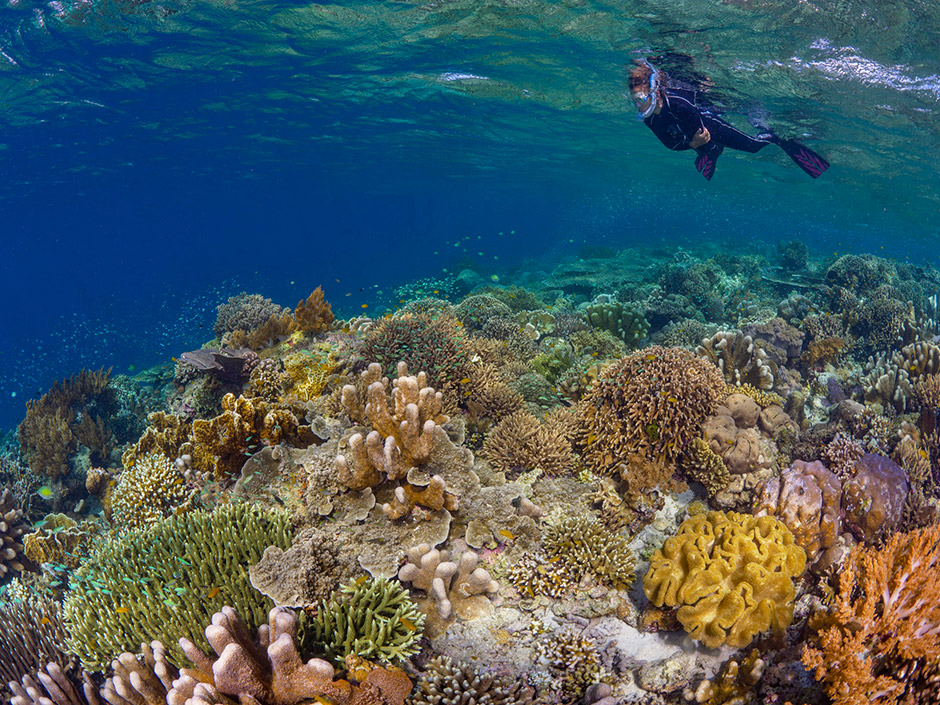

Halmahera Diving is not only about remote reefs and rare marine encounters. In Patinti Strait, the experience becomes more technical, more dynamic, and more rewarding for divers who understand how to read currents, listen carefully to briefings, use reef hooks responsibly, and position themselves safely in moving water.
Why is the Patinti Strait Special for Drift Diving?
Patinti Strait lies in South Halmahera, where ocean currents play a major role in shaping the diving experience. Unlike calm reef sites where divers can move slowly in almost any direction, Patinti is defined by flow. Currents move through the strait, carrying nutrients that feed reef life and attract schooling fish.
This is why the site appeals to experienced divers. The current can bring action, including fusiliers, surgeonfish, snappers, barracudas, reef sharks, and occasional encounters with larger pelagic species. The underwater topography can also affect how the water behaves. Corners, ridges, reef slopes, channels, and sheltered coral blocks can all create different movement patterns.
For divers planning a Halmahera liveaboard, Patinti Strait is often the kind of site that makes the journey feel adventurous. It is not just a place to look at marine life. It is a place where divers must participate with the ocean and understand how to move with it.
How Should Divers Read the Current Before Entering?
Current reading begins before the dive. Divers should observe the water surface, listen to the guide, and understand the planned direction of movement. Surface ripples, boat drift, tide timing, floating particles, and current lines can all give clues about what is happening below.
On a liveaboard route, the crew and guides usually check the site before entry. They may use local knowledge, tidal information, visual observation, and sometimes a current check from the tender. This matters because conditions can change quickly, especially in narrow straits where water is pushed between islands.
For Halmahera Diving, current awareness is part of the experience. Divers should ask where the current is expected to start, whether there may be a split current, where the group will descend, and what the exit plan looks like. The safest divers are not the strongest swimmers, but the ones who understand the plan before entering the water.
What Should Be Covered in the Dive Briefing?
A proper drift-dive briefing should be specific. It should explain entry method, descent speed, maximum depth, expected current direction, potential current changes, reef hook use, hand signals, buddy positioning, SMB deployment, and the pickup procedure.
Divers should also understand what to do if separated from the group. In many drift dives, the correct action is not to swim against the current. Instead, divers should stay calm, ascend safely if needed, deploy an SMB, and wait for boat pickup, as briefed.
This is especially important when diving in Indonesia, where sites can vary dramatically between calm coral gardens and fast-moving channels. A good briefing helps the group move as one unit. It reduces confusion, protects the reef, and allows divers to enjoy the site without fighting the ocean.
When Should You Use a Reef Hook?
A reef hook can be useful in a current, but it must be used carefully. The purpose is not to pull yourself across the reef or anchor into living coral. It is used to hold position in the water column, usually by attaching to dead rock or a safe, non-living surface under the guidance of an instructor.
In the Patinti Strait, a reef hook may help divers pause near a ridge or current-facing area where fish gather. The benefit is energy control. Instead of constantly finning, divers can stay stable, watch the action, and avoid drifting past the site’s highlight too quickly.
However, reef hooks are not always necessary. Some dives may be better enjoyed as a full drift. Others may require short holds in selected areas. Divers should never use a hook without understanding where to place it, how to release it quickly, and how to avoid damaging marine life.
How Should Divers Position Themselves in Currents?
Good positioning is one of the most important skills in drift diving. Divers should maintain horizontal trim, keep fins away from the reef, and avoid sudden movements. A streamlined body position reduces drag and makes it easier to move with the water.
When the group is drifting, divers should stay close enough to see the guide and buddy but not so close that they collide. In a stronger flow, vertical positioning matters. Sometimes being slightly lower or higher can reduce the current’s pressure. Guides often use hand signals to indicate where the group should move.
During Halmahera Diving, positioning can also affect what you see. Fish often gather in current-facing areas, while macro life may hide in more sheltered coral blocks. A calm diver who understands position will see more and use less air.
What Safety Gear Matters Most?
For a current-focused dive, every diver should carry a dive computer, SMB, reel or spool, whistle, and proper exposure protection. A cutting tool can also be useful, depending on local rules and operator guidance.
An SMB is especially important. In drift diving, the boat may pick up divers at a point away from the original entry point. A visible marker helps the crew track the group during ascent and at the surface.
A reliable diving boat is also part of the safety system. The crew needs to follow bubbles, monitor current direction, manage pickups, and stay ready if divers surface separately. On remote itineraries, coordination among guides, the captain, tender crew, and divers becomes essential.
Who Is Patinti Strait Best For?
Patinti Strait is best for divers who are comfortable with drift diving, controlled descents, buoyancy, reef awareness, and group discipline. It is not the best site for someone who still struggles with air consumption, uncontrolled ascents, or nervous reactions in moving water.
That does not mean the site is only for technical divers. Recreational divers with good experience can enjoy it safely when conditions are appropriate. The key is honesty. Divers should communicate their comfort level before the dive so the guide can plan the best approach.
Travellers joining a diving yacht or a Wallacea dive cruise should see Patinti as a skill-based highlight. It rewards preparation, patience, and trust in the briefing.
Why Liveaboards Are Ideal for Patinti Strait
Remote sites like Patinti are easier to access by liveaboard because the region spans long distances. A liveaboard allows divers to wake near the site, time dives around conditions, and adjust the itinerary based on weather and current.
This flexibility is valuable for Halmahera Diving. Instead of forcing a dive at the wrong time, the team can choose better windows. Vessels such as Ambai liveaboard and Seahorse liveaboard are designed for this style of remote diving, where comfort, dive infrastructure, and experienced guidance all matter.
Final Thoughts
Patinti Strait is a reminder that great diving is not always passive. Sometimes the best sites require awareness, technique, and respect for moving water. The current is not an obstacle. It is the reason the site is alive.
For divers who want remote reefs, schooling fish, stronger conditions, and a more technical drift experience, Halmahera Diving offers a compelling way to explore one of Indonesia’s less-crowded underwater frontiers.